Anna Maria ‘Settela’ Steinbach was born on 23 December 1934 in Buchten, a small village in the province of Limburg, Netherlands. A surviving film scene from 1944, which shows her being transported from the Westerbork camp, made this Sinti girl a symbol of the Holocaust for decades.
Early Life and Family
Anna Maria Steinbach was the seventh of ten children of Heinrich ‘Moeselman’ Steinbach (1901–1946), a peddler and violinist, and Emilia ‘Toetela’ Steinbach, née Steinbach (1902–1944), a fortune teller. Her brothers and sisters, all born in the Netherlands, were Magdalena (1922–1944), Willem Hendrik (1925–1945), Elisabeth (1926–1945), Celestinus ‘Willy’ (1929–1944), Johanna Cornelia (1930–1945), Philibert (1932–1944), Florentine (1937–1944), Wilhelm (1939–1944), and Anne Maria (1942–1944). The Steinbach family belonged to the Sinti community and earned their living as itinerant traders across Limburg and North Brabant.
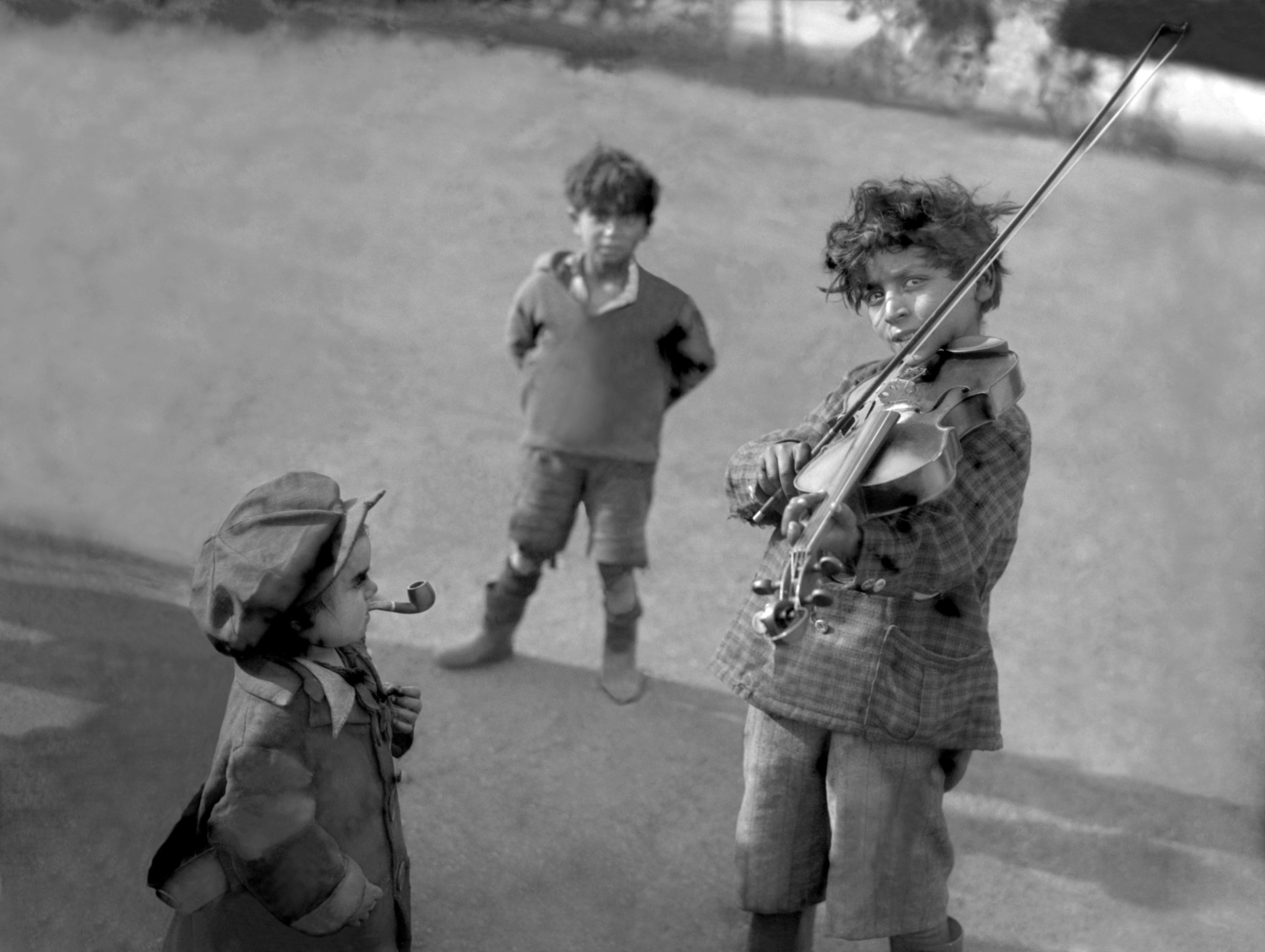
Celestinius „Willy“ Steinbach (1929–1944), rechts, sein Bruder Philibert (1932–1944), Mitte, und sein Cousin Frans (links) in Brunssum, Niederlande, 1935. Celestinus Steinbach war eines von zehn Kindern des Ehepaares Heinrich und Emilia Steinbach. 1943 wurde die Familie zwangsweise in einem Lager in Eindhoven, Niederlande, festgesetzt. Zusammen mit seiner Mutter und acht Geschwistern wurde er am 16. Mai 1944 über das Durchgangslager Westerbork in das Konzentrations- und Vernichtungslager Auschwitz-Birkenau deportiert. Niemand überlebte, auch seine Schwester Anna Maria „Settela“ Steinbach (1934–1944) nicht, von der eine kurze Filmsequenz vom Abtransport im Deportationszug überliefert ist. Celestinus Steinbach wurde am 2. August 1944 nach Buchenwald transportiert, jedoch am 25. September wieder nach Auschwitz-Birkenau überstellt und dort ermordet.
Die Abbildung stammt aus einer Sammlung von rund 3 600 Glasnegativen, die im Limburgs Museum in Venlo, Niederlande, überliefert sind. Sie stammen meist von dem Fotografen Jan de Jong. Den Umschlag für dieses Motiv beschriftete er mit den Worten: „J6578, 30. März 1934, Brunssum. Der kleine Geiger.“ Recherchen ergaben, dass die Aufnahme 1935 erfolgt sein muss. Erst im Jahr 2014 identifizierte der Belgier Rob Hendrikx den Jungen mit der Violine als Celestinus Steinbach. Das Limburgs Museum besitzt drei weitere Glasnegatvie aus dem Jahr 1935, die Mitglieder der Familie Steinbach zeigen.
Fotograf: Jan de Jong
Limburgs Museum, Venlo, L18938
Immobilisation, Arrest, and Deportation
Settela Steinbach’s elder sister Magdalena had moved to Belgium before the family’s arrest in the Netherlands. On 15 January 1944, she and her six-month-old daughter Jeanette were deported from the Mechelen (Malines) transit camp in Belgium to Auschwitz-Birkenau concentration and extermination camp, where both died a few weeks afterwards.
In July 1943, the Nazi-imposed Travel Ban also forced Sinti and Roma in the Netherlands to settle in fixed locations. The Steinbachs were directed to the caravan camp ‘De Zwaaikom’ in Eindhoven. On 12 May 1944, Heinrich ‘Moeselman’ Steinbach and six other men from ‘De Zwaaikom’ were arrested under the pretext of passport inspections. Steinbach was sent to the Amersfoort Police Camp. There he appeared on a 25 May 1944 transport roster for forced labour in Wuppertal and Düsseldorf, Germany. Instead, he and his relatives were placed in a labour detachment at Soesterberg airfield, province Utrecht. On 19 June 1944, Heinrich Steinbach’s name surfaced again in the police logbook of Assen, which recorded his transfer to Westerbork camp. After a short stay there, he was unexpectedly released and returned to Eindhoven on 21 June 1944.
Meanwhile, on 16 May 1944, Settela Steinbach and her mother and siblings were arrested during the Nationwide Round-Up [‘Zigeunerrazzia’] and transferred to Westerbork. On 19 May, they were deported to Auschwitz-Birkenau concentration and extermination camp in wagon 16, which carried 75 people. Among them was Theresia Wagner (1927–2002), who had been arrested with her family in The Hague. Other branches of the Steinbach family lived in Amsterdam and Limburg and were immobilised and targeted for persecution as well.
Auschwitz-Birkenau
Upon arrival, the Steinbachs were placed in Camp Section BIIe. The date of Settela Steinbach’s death is uncertain: some sources list 31 July 1944, others the night of 2 to 3 August 1944, when the last approximately 4,300 Roma and Sinti held in Camp Section BIIe were murdered in the gas chambers.
Her mother and younger siblings also perished there. Brothers Celestinus and Willem Hendrik were transferred to Buchenwald concentration camp: Celestinus was sent back to Auschwitz with a group of young prisoners and died on 27 September 1944; Willem Hendrik was moved to Ellrich, a satellite camp of Mittelbau-Dora, where he died on 28 January 1945. Elisabeth and Johanna Cornelia were declared dead by the Red Cross as of 24 April 1945. Only Heinrich Steinbach survived. After his return to Eindhoven on 21 June 1944, he was assigned to forced labour at the local Philips factory. He died in Maastricht in 1946, reportedly of grief over the loss of his family.
Seven Seconds Caught on Film
At the request of the commandant of Westerbork, Albert Konrad Gemmeker (1907–1982), Jewish filmmaker and Westerbork inmate Rudolf Breslauer (1903–1945) filmed the deportation of 19 May 1944.
In one sequence, Settela Steinbach can be seen for seven seconds, peering from behind the cattle wagon door, a white headscarf wrapped around her shaved head. The image became world famous as an icon of the Holocaust, long assumed to portray a Jewish girl.
In 1994, journalist Aad Wagenaar (1939–2021), with the help of Theresia Wagner, identified her as ‘Settela’. For decades, the image symbolised the persecution and murder of Jews; its re-identification as that of a Sinti child broadened awareness of the genocide of Sinti and Roma.
Photographs
It was long thought that Settela Steinbach’s seven-second film was the only image preserved of the girl. In 2010, however, the book ‘The Glass Album of Limburg’ was published. It was an overview of the approximately 3,600 glass negatives from the 1930s that belong to the collection of the Limburgs Museum in Venlo.1Cf. https://ons.limburgsmuseum.nl/en/story/de-vergeten-vervolging-80-jaar-na-de-razzia-op-sinti-en-roma/216899?slide=16 [accessed: 22/09/2025]. Almost all of them were made by the photographer Jan de Jong (1898–1971), who captured mainly the southern Netherlands for various magazines.
In 2014, an amateur historian, Rob Hendrikx (born 1955), from Lanaken, Belgium, discovered a photograph in a book that the photographer titled ‘Brunssum. In the trailer camp: the little violinist.’ In the photo, Rob Hendrikx recognised Celestinus Steinbach, an older brother of Settela Steinbach. It then turned out that the Limburgs Museum has three other glass negatives that Jan de Jong made in the trailer camp in 1935. They show many members of the Steinbach family, including the 10-month-old Settela Steinbach being carried on the arm of her sister Elisabeth Steinbach.
Aftermath
Settela Steinbach has become one of the most recognisable faces of the genocide of Sinti and Roma. Her story has inspired scholarship, novels, and commemoration. The haunting film still, long shrouded in anonymity, now endures as a symbol of both the Holocaust and the genocide of Sinti and Roma.